Karaftou Cave: A timeless sanctuary of history, art, and faith in western Iran
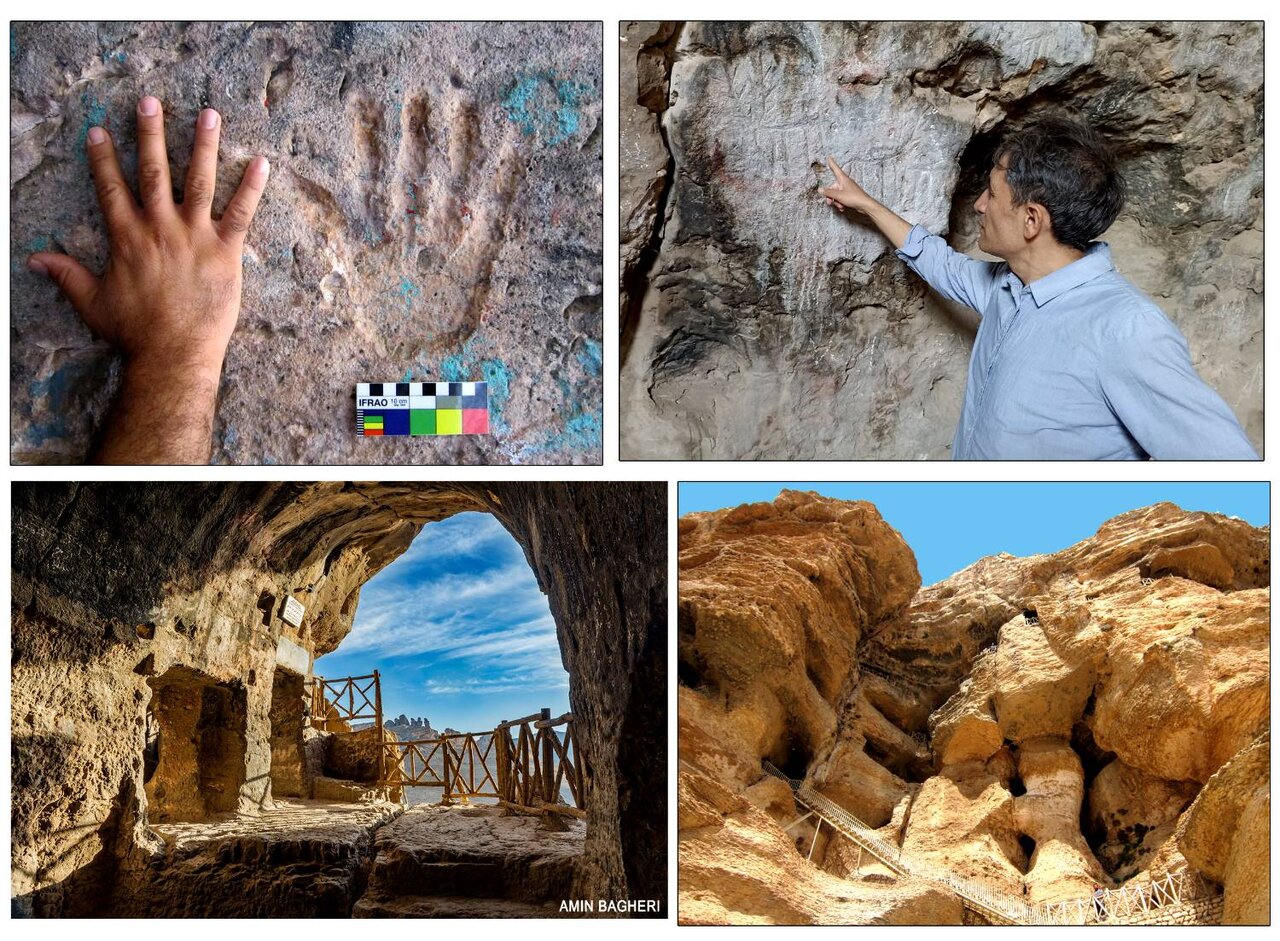
TEHRAN – Karaftou Cave, nestled in the rugged limestone cliffs of Iran’s Kordestan province some 53 kilometers east of Saqqez and 46 kilometers northwest of Divandarreh, stands as one of the country’s most enigmatic and historically significant archaeological sites.
This remarkable complex of natural and hand‑cut caverns, often called the “House of Hercules” because of a Greek inscription on its walls, bears witness to a layered past that stretches from late prehistoric times through the Islamic era. Extending about 750 meters in length and arranged over four distinct levels, the cave blends natural karstic formations with sophisticated troglodytic architecture: its hand‑cut sections include rooms, corridors, stone staircases, windows, and lighting shafts that reveal engineering skills comparable to the architectural traditions of the historical period. Yet it is the rich collection of rock art and the famous Greek inscription that have captivated archaeologists and historians for nearly two centuries.
The first European to write about Karaftou was the British army surgeon Dr. John Cormick, personal physician to Crown Prince Abbas Mirza, whose unpublished diary later informed Sir Robert Ker Porter’s 1819 travelogue, in which Porter recorded the cave and its inscription. In 1838, Sir Henry Rawlinson visited and provided an improved reading, passing his copy to the topographer William Martin Leake, who astutely recognized that the site was under the protection of Herakles, suspected the two lines might be verses, and dated the script to the 4th or 3rd century BCE.
In the summer of 1936, Sir Aurel Stein explored the cave over three days, producing a plan of the chambers and taking a squeeze of the inscription that allowed Marcus N. Tod to confirm an early Hellenistic date, between the end of the 4th and the beginning of the 3rd century BCE. Rudolf Naumann and Hubertus von Gall visited in 1975, resulting in an improved plan and the first photographs of the interior. The inscription above the door to one of the chambers reads, “Herakles resides here, nothing evil may enter.” Von Gall, revisiting earlier suggestions by Johannes Franz and W. W. Tarn, proposed identifying Karaftou with Mount Sanbulos mentioned in Tacitus’s Annals—a mountain in Media where local deities, chief among them Heracles, were venerated during the Parthian conflict between Gotarzes II and his rival Meherdates around 49/50 CE. Von Gall supported Stein’s conclusion that the cliffs match Tacitus’s description and that the rock chambers functioned as an oracular sanctuary dedicated to a local god whom the Greeks called Heracles. Drawing on comparative material from Greek sanctuaries, he noted the accurately carved barrel vaults, devices for barring doors from the inside, and lintel elements reflecting wood architecture—all signs of sophisticated design. He argued that the limited outlook and absence of residential facilities rule out a military or purely domestic function, while the remnants of a broad staircase suggest solemn ceremonial processions and traces of a meḥrāb confirm Islamic‑period use for prayer. Ultimately, von Gall proposed that the chambers likely served multiple purposes—some as assembly halls for feasting and meetings, others for religious rites—and drew a parallel with the Hyrcanian caves described by Strabo, where people gathered amid scenic splendor for both sacrifice and pleasure, suggesting that Karaftou similarly blended the sacred and the social.
Taher Ghasimi, a Ph.D. student in Archaeology at the University of Mazandaran and a leading specialist in Iranian rock art, has conducted extensive research at Karaftou. He believes one of the most significant challenges in the study of Iranian rock art has been the lack of a firm chronological framework; many researchers have traditionally attributed such motifs to the late Pleistocene and early Holocene, but recent field studies, particularly those at Karaftou, are offering new insights that could reshape
our understanding. Ghasimi and his colleagues argue that Karaftou can serve as a chronological basis for the study of rock art across Kordestan province, and his previous field investigations suggest more recent dates for many motifs, with Karaftou’s findings instrumental in recalibrating the regional chronology. The interior walls and surrounding rock shelters are adorned with a diverse array of petroglyphs, which Ghasimi’s team has systematically documented into four categories: human figures, animal motifs, compound human‑animal forms, and geometric or symbolic designs. Among the most significant are depictions of horsemen shooting arrows backwards, a technique famously associated with the Parthian military tactic known as the “Parthian shot.” In his analysis, Ghasimi draws parallels with similar representations on Parthian and Sasanian silver and golden vessels, and together with the Greek inscription, architectural features, and pottery finds, he concludes that some motif complexes, particularly those in the man‑made spaces, were likely created during the Seleucid‑Parthian or Sasanian periods. The cave also features numerous geometric motifs, including lozenges, circles, horseshoe‑shaped symbols, and human handprints, found both inside and in nearby rock shelters; similar motifs at Iron Age sites such as the Kul Tarike Cemetery suggest a continuity of symbolic expression over millennia.
According to Ghasimi, the cave appears to have served multiple functions over time: a temporary shelter, a place of worship, and a refuge during times of conflict, though its role as a sanctuary remains especially significant. In November 2022, the site was added to UNESCO’s tentative list for World Heritage status, its unique blend of natural beauty, historical architecture, and artistic heritage making it a strong candidate for international recognition. However, the rock art has suffered severe damage from natural erosion and human activity, including graffiti left by visitors over the past century; fortunately, most of the graffiti were cleaned under the supervision of Ali Hozhabri in 2015. Ghasimi’s research highlights the urgency of preservation efforts, noting that most surfaces bearing these motifs have been damaged since the late 1800s, making it difficult to distinguish their details. For Ghasimi, Karaftou is more than an archaeological site; it is a living archive of human creativity and belief, a complex of natural caverns whose entrance and some passageways were modified during the historical (Parthian) period, and whose walls bear witness to the artistic and spiritual expressions of the peoples who sought shelter and meaning within its chambers over millennia.
AM
Leave a Comment